Author: info

Kisima African Giving Platform

Launched on 29 September 2021, the Kisima African Giving Platform is a project supported by the Open Society Initiative for Southern Africa and several other partners, that seeks to promote good giving stories and mobilise resources that can be deployed whenever a disaster strikes in any part of the continent.

This platform was inspired by research on the impact of COVID-19 on three sectors -philanthropy, civil society and corporate social investments. The findings of the research showed that people across the continent of Africa are always ready to help each other in times of need. The COVID-19 pandemic and previous humanitarian disasters have demonstrated the giving nature of Africans and raised the need to articulate the way in which all Africans in the continent and in the diaspora have contributed financially and otherwise to development.

If Africans can rally together and pool their resources as a collective, there is no challenge that they cannot overcome.

The Kisima African Giving Platform comprises of three components. The first component is the repository of good and positive African stories of giving and support across the board. These stories will be showcased in the form of voice notes, images, Instagram stories, YouTube short films, blogs, and research articles. These will be stories of resilience and giving among Africans. We will invite Africans to give and deposit their stories through the initiative.

The second component of the initiative consists of a campaign to raise funds and other forms of resources towards specific continental causes or needs. The third component of the initiative consists of reporting on the impact of giving, firstly as it relates to the initiative; and secondly on the impact of giving across the continent from national, regional and continental initiatives.

“We have to position Africans themselves in the position where they are the storytellers, you cannot have somebody else tell your story and expect it to be your narrative, so we need to have Africans telling their own stories.” – Dr Bhekinkosi Moyo (Director, Centre on African Philanthropy and Social Investment)

Learn More About the Kisima Initiativehttps://www.kisimagiving.org/

Submit your stories: https://www.kisimagiving.org/submit-a-story/

For more information about the Kisima African Giving Platform, contact: Mapaseka Mokwele at mapaseka.mokwele@wits.ac.za

HIV AT 40: A World Aids Day Premiere

We are proud to share with you our contribution to the “HIV at 40: A Worlds Aids Day Premiere” programme.

“HIV at 40” was produced in order to raise awareness for HIV, explore current testing and treatment, and looking at what the future of HIV may look like. Produced in partnership with ITN Productions Industry News and hosted by Belle Donati, this special production marks the 40th anniversary of the first AIDS related death in the UK.

Launched on World Aids Day, this news-style programme showcases the innovative work done by Wits Business SchoolCentre on African Philanthropy and Social InvestmentReckittGilead SciencesUNAIDS and the groups (Girl Lead, Imbokodo, Aganang and Gratitude) as they try to solve challenges related to HIV/AIDS infections, early teen pregnancies and STIs. Filmed in Tsakane, South Africa, the groups are making a huge difference in the lives of young girls and boys.

The programme also spotlights the work of the British HIV Association, Elton John Aids Foundation and Terrance Higgins Trust and how they are exploring thoughts on HIV, how treatment has developed in the last 40 years, and how they are helping to end the epidemic. As well as interviews and case studies featuring leading organisations, The G20 Partnership, Gilead Science, IFPMA, MAC Viva Glam, Theratechnologies and ViiV Healthcare, showcasing how they were making a difference in the charge to a world free from AIDS.

Watch Now:

HIV at 40: A World Aids Day Premiere

Call for Submission: 2022 ISTR Emerging Scholar Dissertation Award

ISTR is pleased to announce the 2022 Emerging Scholar Dissertation Award. This award is presented biennially for a PhD dissertation completed or defended in the two calendar years (July 1, 2019 to June 30, 2021) preceding the award. Self-nominations are accepted.

Dissertations that contribute to the field of comparative study of civil society organizations, non-governmental organizations (NGOs), philanthropy, voluntarism and related issues are eligible. We encourage submissions of PhD dissertations from all parts of the world. Dissertations focused exclusively on the United States are not eligible.

The winner will be announced and the award will be given at the ISTR 15th International Conference in July 2022. The award is US $1,000.

Dissertations may be submitted in English, French, German, Spanish, and Portuguese.

Applications must include:

  • Letter of acceptance for the degree
  • A summary of the dissertation that clearly states: the dissertation’s subject matter, research question(s) addressed, the approach taken, key finding(s), and the dissertation’s specific contribution(s) to the field. This needs to be in English and not exceed 1,000 words in total (i.e. including any references, etc.). Submissions that do not comply with this word limit will not be considered.
  • One full copy of the dissertation

Deadline to submit a nomination: January 15, 2022.

Entries will be judged by a committee based on the following:

The dissertation’s contribution to the study of, knowledge on, and understanding of the Third Sector and/or related fields
The dissertation potential to influence new thinking on the Third Sector and/or related fields
For inquiries or questions, contact:  Margery Daniels, Executive Director (mdaniels@istr.org)

Submit your nomination: https://www.istr.org/page/DissertationISTR

call-for-applications-the-innocent-chukwuma-african-ngo-leadership-transition-fellowship-program-icltfp-2022

CALL FOR APPLICATIONS: The Innocent Chukwuma African NGO Leadership Transition Fellowship Program (ICLTFP) 2022

The Association for Research on Civil Society in Africa (AROCSA) in partnership with the Centre on African Philanthropy and Social Investment (CAPSI) is pleased to announce this call for applications to the Innocent Chukwuma African NGO Leadership Transition Fellowship Program (ICLTFP), formerly known as the African NGO Leadership Transition Fellowship Program (LTFP). The Fellowship is funded by the Ford Foundation.

The decision to rename the program after Innocent Chukwuma, who until his death in April this year, was the regional director of the Ford Foundation West Africa office, arose from the combination of the significant role he played in setting up AROCSA and establishing the LTFP; AROCSA’s consideration of the best way to honour his legacy; and from suggestions from some of the members of the last cohort of the LTFP which took place for the first time on African soil in Ghana from 1st March to 30th May, 2021.

At AROCSA’s last quarterly board meeting which took place in September 2021, a unanimous decision was made to rename the program after Innocent Chukwuma. The decision was subsequently communicated to his family through his wife; Mrs. Josephine Chukwuma, who was deeply appreciative of the consideration, and happy to give her blessings to AROCSA’s request. Her personal statement on the role Innocent Chukwuma played in the birthing of AROCSA and the establishment of its key programs is appended to this Call. We pray that his soul continues to rest in perfect peace and that the Almighty continues to give his family the strength to bear his loss.

As part of efforts to further ground the program in the realities of the African experience, AROCSA is partnering with the Centre on African Philanthropy and Social Investment (CAPSI) at the Wits Business School in Johannesburg, South Africa to deliver the next couple of iterations of the program.

About the program

The Africa Leadership Transition Fellowship Program (LFTP) began in 2018 under the moniker of the Nonprofit Leadership Transition Fellowship Program (NLTF Program), with support from the Association for Research on Nonprofit Organizations and Voluntary Action (ARNOVA) and the Ford Foundation. It was started in recognition of the urgent need for an NGO leadership transition program to aid sector leaders – civil society and NGO leaders – who are considering transitioning out of their positions by creating a supportive infrastructure.

The program’s chief purpose is to help sector leaders prepare and position their NGOs to be sustainable, vibrant, and continue to thrive after their exit from the organization. The program enables both the leaders and organizations to successfully make the shift, and in so doing create spaces for a new generation of leaders in the social sector to not only emerge but also have platforms to apply their creative and youthful energies. Transitioning leaders would develop succession plans within their own organizations, contemplate their personal transition plans, and document their knowledge and experience.

Objectives of the program

The objectives of the ICLTFP are to:

1. Contribute to the process of establishing a supportive infrastructure for leadership transition within the NGO/CSO movement in Africa.

2. Promote the creation of leadership spaces for the next generation of leaders in African civil society to grow and strive.

3. Increase the documentation of leadership experiences/reflections and renewal processes within civil society in Africa.

Timeframe

This iteration of the program will run for three months between March and June, 2022.

Application Process

Applicants are required to apply for the Fellowship through the electronic application portal on the AROCSA website. Applications must include the following:

  1. I. Completed electronic application forms
  2. II. Copy of valid international passport (must be valid for six months from March 2022)
  3. III. Curriculum Vitae
  4. IV. Two letters of recommendation (including one from the NGO Board Chair indicating that the board is aware and approves of the applicant’s participation in the fellowship)
  5. V. 3-5 page (double space, 12pt font with one-inch margins) personal statement that includes, but not limited to, the reason for participating in the fellowship and anticipated fellowship objectives that the applicant seeks to achieve

*If selected, you will be required to complete and document a comprehensive assessment of your health status. To view the medical form and familiarize yourself with required medical examinations, please click here.

October 11th, 2021 Applications open
November 15th, 2021 5:00 PM WAT Application deadline (all materials must be submitted by this time)
December 5th, 2021 Selection process begins (reviews and Zoom interviews)
January 15th, 2022 Awardee Notification
March 14th – April 14th, 2022 One month placement at CAPSI
April 14th – June 14th, 2022 Remote facilitated career planning and documentation
June 6th – 10th, 2022 Fellow chapter presentations
June 13th, 2022 Fellowship group debrief session
June 14th, 2022 Program ends

For any questions or enquiries, please email programs@arocsa.org with the subject ‘ICLTFP 2022’  

To apply click: here

2021 CAPSI/WITS PHD Writing and Methodology Workshop

Workshop Dates: 3 – 9 October 2021

Venue: Wits Rural Facility, Acornhoek Mpumalanga

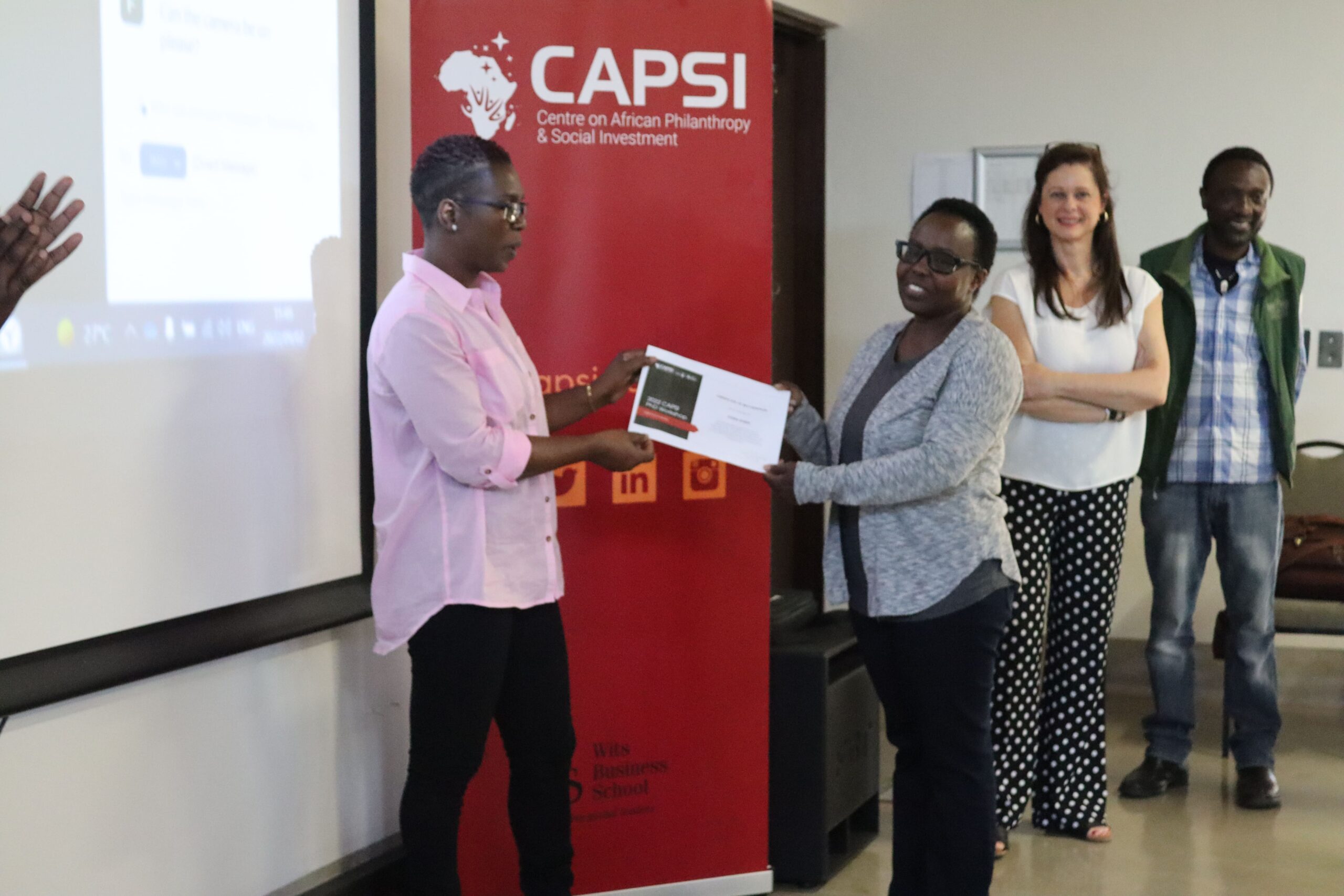
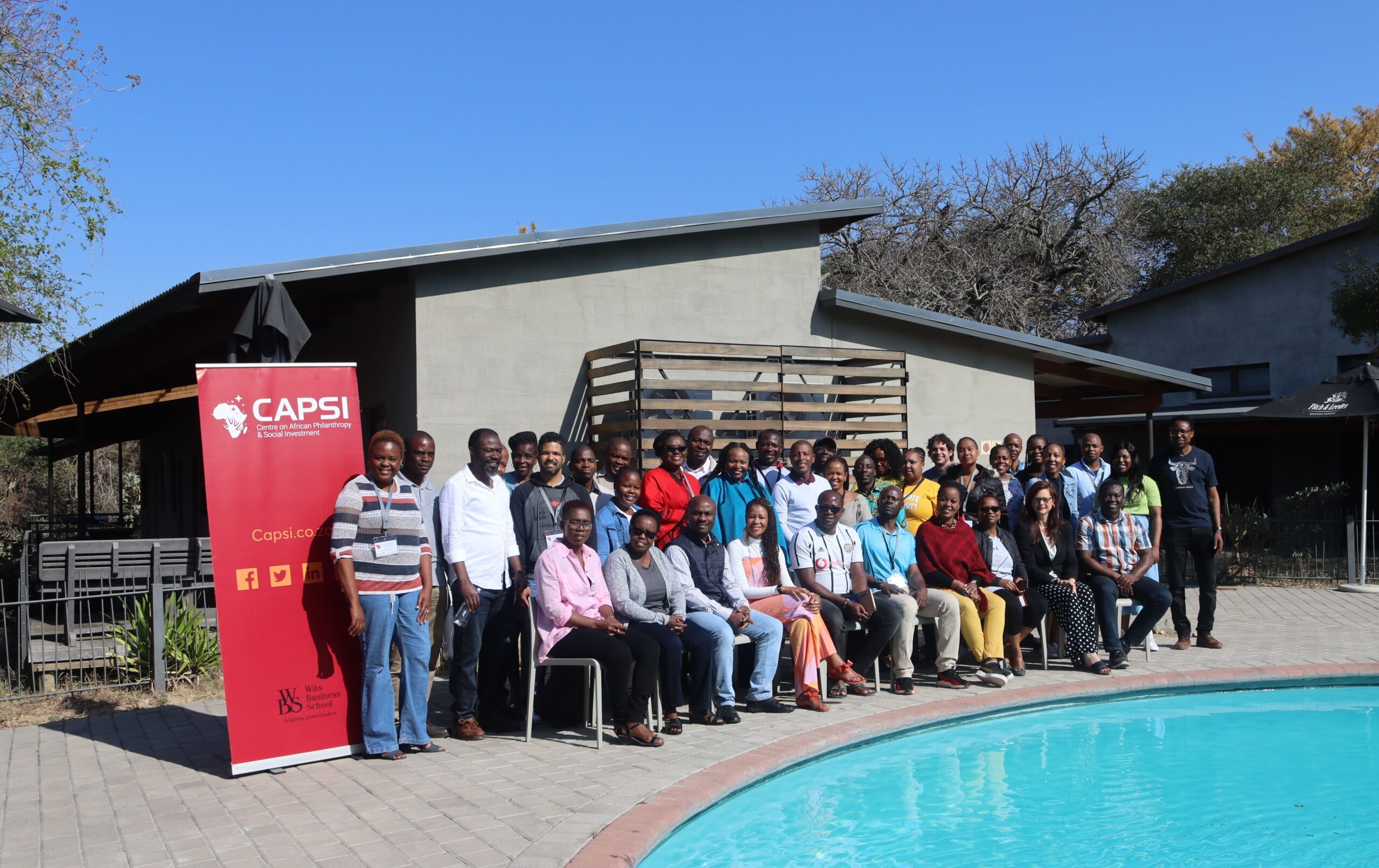
The Centre on African Philanthropy and Social Investment at Wits Business School hosted a PhD Writing Retreat for approximately 30 PhD students across Africa. The writing retreat included both workshops and presentations of paper/proposals by successful applicants.

All registered PhD students at the Wits Business School and across African universities were cordially invited to apply to participate in a Writing and Methodology Workshop. To apply, students were required to submit the following documents:

  • A motivation letter indicating how the workshop would be beneficial
  • Proof of registration from their University
  • Letter of support from their supervisor
  • Their current research proposal/ draft thesis

The workshop had the following objectives:

  • Improving writing skills
  • Planning and developing each chapter
  • Developing research questions and conceptual frameworks
  • Writing the problem statement
  • Planning the literature review
  • Developing the research methodology – quantitative and qualitative
  • Individual coaching on your own research study
  • Ethical considerations and preparing for ethical clearance
  • Writing for academic journals
  • Project management for the thesis

Winners of Presentations

The final day of the retreat allowed the students to present their thesis work and they were assessed on the following criteria:

  • A well-defined research problem substantive contribution to knowledge
  • Sound and appropriate use of theory and methodology                                              
  • Comprehensive Methods                                                         
  • Ability to use technical and academic language                                               
  • Ability to engage with the audience        

Our winners and their topics were:

Student Topic
Albert Kagande An alternative model for the financial sustainability of local NGOs in the social services sector in the Eastern Cape, South Africa.
Tabea Kabinde A Model to Complement Legislation in Accelerating Employment Equity In South Africa. An alternative view to dealing with the impasse created by power in the successful implementation of employment equity.
Sylvester Senyo Horvey Enterprise Risk Management, Corporate Governance and Insurers Risk-Taking in Ghana and South Africa: Evidence from Dynamic Panel Threshold.
Edward Ngubane Cloud Computing adoption and SMME development in South Africa.
Ntsoaki Mokala Investigating teachers’ narratives of their teaching experiences of learners with hearing impairment in a special school.

African Philanthropy Conference 2021


Download the Conference Programme PDF

About the Conference

This is the second African Philanthropy Conference held under the banner of The Centre on African Philanthropy and Social Investment (CAPSI) in collaboration with the Africa Philanthropy Forum (APF), African Philanthropy Network (APN), East Africa Philanthropy Network (EAPN), Southern Africa Trust, Harvard Center for African Studies and TrustAfrica. The first conference took place in 2019 and was a success leading to partners agreeing to hold one every year. The COVID-19 pandemic however happened and all plans for 2020 were aborted. The world has changed since March 2020. Life, as we know it, has changed; work models have shifted; economies have shrunk, and livelihoods have been severely affected. The devastation by the pandemic is immeasurable, yet amid this, the world of philanthropy has also witnessed huge amounts of giving in-kind and cash. Communities, individuals, corporates and various forms of philanthropic organizations have all responded to the pandemic and addressed the negative effects of COVID-19.

The Conference is an opportunity for everyone involved to celebrate African philanthropy and the many stories of resilience; showcase various innovations and creative responses; assess the impact and begin to make sense of the world with and beyond COVID-19. There are three main themes that the Conference will unpack in seeking to understand philanthropy in the context of the pandemic. The first is ‘Celebrating African Philanthropy’. The second is a focus on ‘Systems change, Virtual platforms and Technology’. The third relates to ‘Uniting Africa’. All three themes are timely and relevant for the current moment but also for building forward better.

Keynote Speakers


Programme and logistics

Due to the ongoing COVID-19 travel restrictions, the conference will be held virtually. Participants will be able to dial in through the online platform provided. 

Thursday 5 August

It is a dream of the African Union and its founding fathers such as Kwame Nkrumah to see a united Africa with free movement of goods and people. Now more than ever, Africa is steadily making progress towards realizing this vision with the new AfCFTA agreement and active youth who are pushing this agenda. This session will deliberate on opportunities to unite the continent through the vaccine rollouts, youth engagement and identify areas where African philanthropy can play a role.

The Centre for Strategic Philanthropy and CAPSI announce landmark partnership

The Centre for Strategic Philanthropy (CSP) at the University of Cambridge and the Centre on African Philanthropy and Social Investment (CAPSI) at the University of the Witwatersrand are delighted to announce a landmark collaborative partnership to further understand the impact of philanthropy across African communities, private sector organisations, foundations, and key individuals.

The partnership aims to increase the development of joint projects between the two Centres to increase theoretical and applied research on philanthropy that meets the standards of academic excellence. Equally, both Centres seek to develop their ongoing education and mentorship programmes and thought leadership outputs, thereby strengthening both their capabilities for analysis and knowledge transfer. This collaboration will better disseminate research and activities that develop models and tools appropriate to Africans’ realities and capitalise on these opportunities to firm the role and impact of various giving mechanisms and institutions.

“We are delighted to formalise this agreement between our two Centres. It is an important step in shifting the power dynamic that has been long overdue for the Global South, particularly in the African philanthropic sector.” – Clare Woodcraft, Executive Director for the CSP.  

“We couldn’t be happier to have the Centre for Strategic Philanthropy on board and I am pleased to see our collaborative efforts continue to grow.” – Dr Bheki Moyo, Director of CAPSI.

The relationship between the two Centres was established in 2020 through several research and development opportunities, including CSP’s ongoing #ShiftThePower seminar series and CAPSI’s recent 2nd African Philanthropy Conference.

NGOs’ Activities and local government spending in upper west region of Ghana: Are they complements or substitutes?

There is an increasing interest in the relationship between non-governmental organisations (NGOs) and local governments in terms of social spending in developing countries. However, the current literature on NGOs and social spending, especially for those pertaining to developing countries and Ghana in particular, does not examine the extent to which NGOs’ presence shapes local authorities’ spending on the provision of basic social amenities. This study examines NGOs’ presence on constituents’ opinion about local government social spending. Using the probit regression estimation approach, this study found that services provided by NGOs might be allowing local government authorities to change their spending patterns and priorities. Thus, the presence of NGOs tends to crowd-out social spending in the Upper West region. To the extent that proliferation of NGOs lowers social spending, local government authorities might also be taking advantage of NGOs operations to neglect their constitutionally mandated responsibility of providing basic social amenities in their communities of practice. This article discusses key implications for policy.

View article

CAPSI/WITS PHD writing and Methodology Workshop

CALL FOR APPLICATIONS

Workshop Dates: 3 – 9 October 2021

Venue: Wits Rural Facility, Acornhoek Mpumalanga

What is covered: Transport, Meals, Accommodation, Wifi and Venue

What you will achieve: Writing skills training, developing research questions, developing research methodology, writing time and supervision

Suitable candidates: All registered PhD students regardless of the research stage. Proof of registrations is required

Closing date for applications: 27 August 2021 before 14h00 SAST

The Africa Centre for Philanthropy and Social Investment at Wits Business School will host a PhD Writing Retreat for approximately 30 PhD students across Africa. The writing retreat will also include workshops and presentations of paper/proposals by successful applicants.

All registered PhD students at the Wits Business School and across African universities are cordially invited to apply to participate in a Writing and Methodology Workshop. The workshop has the following objectives:

  • Improving writing skills
  • Planning and developing each chapter
  • Developing research questions and conceptual frameworks
  • Writing the problem statement
  • Planning the literature review
  • Developing the research methodology – quantitative and qualitative
  • Individual coaching on your own research study
  • Ethical considerations and preparing for ethical clearance
  • Writing for academic journals
  • Project management for the thesis

To apply, you are required to submit the following documents:

  1. A motivation letter indicating how this workshop will be beneficial to you
  2. Proof of registration from your University
  3. Letter of support from your supervisor
  4. Your current research proposal/ draft thesis

These documents must be submitted to mmabatho.leeuw@wits.ac.za by 27 August 2021 at 14h00 SAST.

Successful applicants should prepare to be away in Mpumalanga for the whole week beginning 03 October. They must be available and able to participate throughout the workshop. All expenses are covered for this workshop.

Enquiries: mmabatho.leeuw@wits.ac.za and thandi.makhubele@wits.ac.za

Notes and T&C:

  • You will need to arrange your own transport to the Wits Business School in Johannesburg to access transportation that will take you to the Wits Rural Facility in Mpumalanga.
  • Registered PhD students in the following disciplines will be considered: Humanities (history, languages, literature, and philosophy), Social Sciences (Anthropology, education, geography, law, political science, psychology, sociology, development and international relations), and Business (Accounting, economics, finance, management, and marketing).
  • A hybrid approach where those based outside South Africa can join online will be considered.
Gerry Salole

Meet the Advisory Board Member: Gerry Salole

Now working as an Independent Consultant, Gerry Salole is the former Chief Executive of the European Foundation Centre, in Brussels. Using his vast experience in international development, he now focuses on helping other organisations with projects, strategy, and trends. 


As a trained Social Anthropologist, Gerry sidestepped an academic career when he accepted a job working with Oxfam Ethiopia where he was subsequently seconded to United Nations High Commissioner for Refugees (UNHCR)on a project repatriating Somalian refugees in Ethiopia. The experience he gained showed him the gaps that (still) exist between organisations wanting to help, but not always addressing the real needs of people.  


His work in development has taken him all over the world: Ford Foundation in South Africa, Bernard van Leer Foundation in The Hague, and various organisations in the USA, Zimbabwe, and Ethiopia, but Gerry says his ‘real’ work experience was gained in Africa. He has seen first-hand the serious impact that refugee camps have on children, and how the parents are very aware of the problems and are willing to communicate these, if someone would listen 

“Most of the people in this business are social engineers, they want to do good and they think they have the answers. The real answers are the people – they know what they need and how they need to do it. And if you listen properly, you may be able to help, but you can’t engineer it for them.” 

While his studies in anthropology helped him to ask the right questions, and listen, it didn’t really provide the answersTo him, anthropology is not a discipline that studies people, it studies with people – he calls himself a ‘participant observer’. Gerry believes that an academic approach is too ‘purist’ to have a real impact. Too much emphasis on qualification, rather than lived experience, is part of the problem in this field.  

“You can’t go in with your own vision of what is happening – you have to actually let the story, the narrative, emerge from the context you’re in.” 

He supports the work that CAPSI is achieving: marrying the tools of academia with real context and not letting one lead the other or become superimposed on one another. Gerry believes that to do better work, development workers need to get better at learning the lessons and listening to what has happened in the past.  


The focus on development in Africa has changed – it’s less about development per se, and more about business, startups and entrepreneurs. There is a recognition that it’s not about receiving handouts or charity – rather about making the available resources work for you. Gerry uses the term bricoleur (someone who is able to create using whatever materials are available), to define the type of skills that are needed in the development field, rather than the typical ‘engineer’ type skillset, one using blueprints or preconceived solutions.    


CAPSI’s placement within a business school provides an opportunity for people to pay more attention to institutions that are embedded in African society. African philanthropy is part of ordinary life, like the Rotating Credit Association and stokvels in South Africa – these are important tools that have been imagined, adopted, and maintained by the people, really owned, yet they are often ignored.  

“I’m hoping that there is going to be a way in which to validate what people do, because they don’t do them for no reason; they don’t do them by accident.” 

Meet the Advisory Board Member: Noxolo Hlongwane

Noxolo is the Head of Philanthropy at Nedbank Private Wealth, responsible for developing the philanthropy offering and strategy. On behalf of the top tier clients of the bank, both high net worth individuals and corporates, the philanthropy offering assists clients who want to give back to society with strategic advice, structuring of their charitable trust, management of the investment portfolio, as well as offering grant-making services.


Noxolo’s upbringing fostered an awareness of inequality and social injustices from a young age.  With the urge to make a positive impact in society, her goal of making a difference at a policy level led her to study Economics, after which she began a successful career in the banking sector. After eight successful years in building her career, Noxolo took a year to do her MBA at the Henley Business School, in the UK. Wanting to marry her strong skills of banking investment with her expertise in the development field, she joined Nedbank, where she could pursue purpose and work in her dream job at the same time.


Working with a philosophy of sustainable and impactful giving, Noxolo has sound advice to those wanting to give back to their communities – start. By initiating engagements with organisations that are making a difference, we can identify where we can get involved with our time, skills and financial resources. She stresses the importance of practising due diligence before donating or getting involved as this allows us to develop good philanthropic practices.

“In the time that we are in, there is such a need for us to extend kindness to the next person – being thoughtful and considerate.”

Reflecting on the inherent African spirit of ‘ubuntu’ – extending kindness – Noxolo wishes the origins of philanthropy, from the Greek word philanthropia, meaning ‘love of mankind’, were more true today, not only about giving money.


The adoption and set up of CAPSI has been so important for the region, helping to get recognition and appreciation for all giving, not just the big donations.

“CAPSI has helped redefine and appreciate philanthropy according to our own terms, in our region – not according to principles and models from elsewhere.”

CAPSI has the opportunity to professionalise philanthropy, providing accredited quality programmes, as well as helping to sensitise the youth earlier on, through formal learning. Translating the research of the organisation into the world of work and business, CAPSI can help businesses to respond to the needs at hand, by addressing the pressure points.

Wycliff Nduga Ouma

Wycliffe Nduga Ouma is a Ph.D. candidate and a Research Associate at CAPSI at the Wits Business School, University of the Witwatersrand Johannesburg. Mr. Nduga has a passion for research and Consultancy in the areas of Social Impact Investing, Impact philanthropy, corporate philanthropy, Financial Markets, Financial Risk Modelling, and International Trade.

Currently involved in many research projects at the centre including comprehensive documentation of philanthropy during the COVID-19 pandemic, a book chapter investigating the impact of COVID-19 pandemic on Civil Society

Organizations in Africa, a research paper on Ubuntu and Philanthropy in Africa and Developing an African Philanthropy Index. Mr. Nduga is also researching exchange rates movements, stock price risk and risk pricing in developing equity markets. Outside the work on philanthropy, Mr. Nduga is a dedicated and loving father who prefers to spend spare time with family.

Q: Your field of study and what inspired you to take this path?

My field of study is in Financial Markets and Capital Markets, essentially Financial Economics.

My PhD is to develop an asset pricing framework for developing equity markets. However, I am a firm believer in knowledge flexibility which puts me at the core of the Centre for African Philanthropy and Social Investment (CAPSI) works.

For about three years now, I have developed keen interest in Philanthropy and Social Investment. I am currently undertaking works (outside the centre) to develop social investment and Impact investing platforms for some personal clients.

Q: What have you learnt or seen that have been vital for your career or that has stood out most for you? 

Coming to the centre has opened new frontiers for me. I find myself having conversations and involvement in research activities target at improving humanity. This was never even a dream I had, but it is slowly becoming my livelihood.


Q: How do you think your research will make an impact in the social investment space?

One, philanthropy in the continent is omnipresent yet invincible. It takes people like us who are investing time to record, document and display what philanthropy is doing on the continent. I believe our work is not only for academics but goes a long way in informing social change needed in Africa.

For instance, by developing an index for philanthropy in the continent, we will have a barometer, a gauge to see where we are and where we should be going as a third sector. Make no mistake, philanthropy is at the core of every developmental agenda, especially in Africa. A clear example is the work philanthropy has done during this pandemic.

Look at the vaccine’s development and distribution, philanthropy is leading the pack.