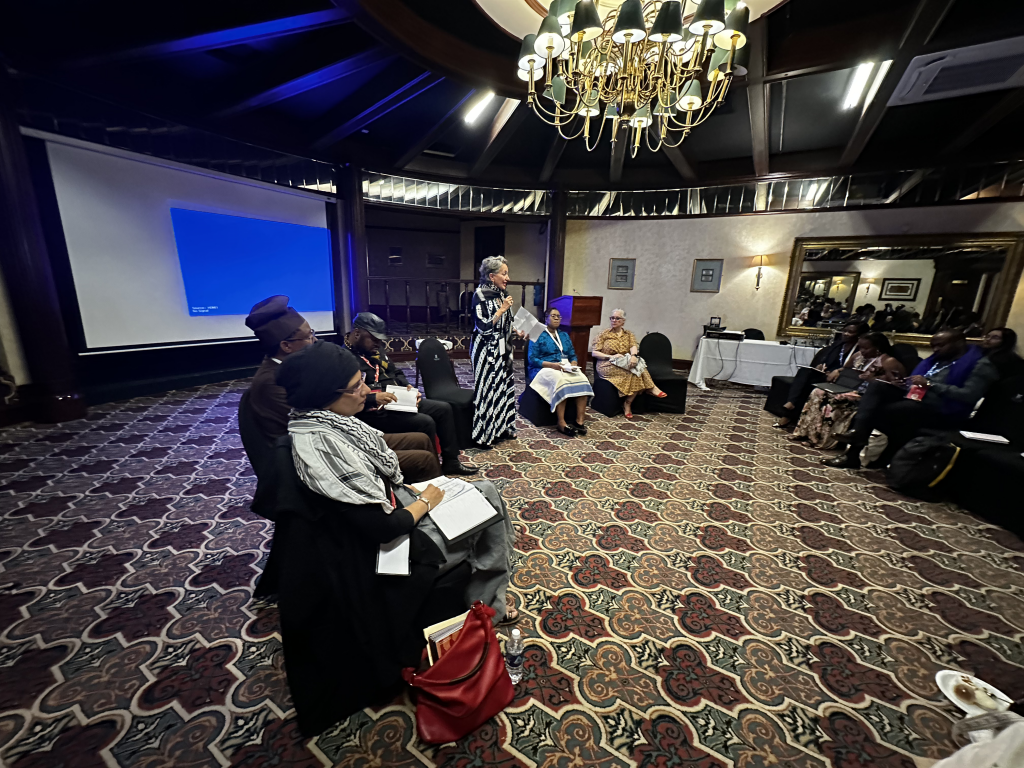
The second African women’s writing retreat and circle, curated by a multi-dimensional partnership of actors such as NAWI, CAPSI/WITS, Adoye; was excellently delivered through thoughtfully prepared daily tutorials. These were skillfully delivered by Karabo, whose knowledge about the writing that is from this continent, is unparalleled.
Jude and Nyamal co-facilitated our introduction sessions and our open evaluation so beautifully, it was a very soothing gift to be held with such care and tenderness as African women. Especially as in many contexts, we either do the holding or, we are on the receiving end of the gruffness of efficiency. To be extended comfort and luxury as African women is something that I will cherish.
To say that they each individually and together went above and beyond is an understatement. We had, with their support, the very rare opportunity to delve very deeply into the truly vast canon of African authorship, reaching all the way back to Amos Tutola’s work. This was such a significant accomplishment. Particularly given that despite its enduring nature, Tutola’s work has been out of print until its recent republication last year, and is therefore not easily available in book stores or in public libraries. Or even taught in schools.
We referenced and held onto the centrality of African women writers who have trailblazed. Flora Nwapa, Ama Ata Aidoo, Sylvia Tamale, Patricia McFadden, No Violet Bulawayo, Mariama Ba; and so many more. It felt, at least to me, as if we were the ones who had inherited a precious treasure trove of sacred texts. Remembering our trailblazers was so vital for us as an honouring of those giants on whose shoulders we peep round and bolt courageously from.
Our reading lists did not only focus on the importance of historical authorship, they also included very contemporary writing from last year, allowing us to appreciate the deep breadth and width of the contributions of African minds to fiction and non-fiction.
There was ample room in how Karabo delivered the tutorials for in-class practice of writing techniques that go against the grain of what has been forged as normal and what has been shaped as the acceptable praxis of Africa’s authors. Her teaching style was so expert as to appear effortless. I heard once that when a body of work appears to have not required effort, that is a testament to just how much love and labour has been poured into it.
With her guidance, we explored how to apply our authorial agency by leaning into crafting our words and worlds through the metaphorical lens that resonates with us and our own world views, rather than falling into the trap of a form of writing that insists that we are mere passive objects of the external eye on Africa and our Africanness.
What a refreshing affirmation of who we are and indeed, seek to be our time together was. Our evenings were devoted to reading circles where we shared our works in progress and received thoughtful feedback on the projects we were attending to. We drew deeply from poetry. From music: Makeba, Fassie, Simone, Holiday, Freddie Mercury for instance.
We grooved. We danced. Teaching each other the routine. How to fold knees and sink shoulders with a bop. I observed how a certain melody from a song evoked memories from our childhoods that we wove into our woke.
We marveled at the inspiration from broad spectrum of African textiles, and how they are dominating couture and fashion, the leather and jewellery industries. We remembered our architecture, design and how it respects nature as its primary source. In honouring all of this we saw how what we have in Africa can lead to the production of work that holds the layered complexity of our brilliance and genius.
We compared the coarseness of our hair, its porosity and offered each other ideas for how to braid it in different styles. This, of course, led to a conversation about how in our collective and individual lineages hair was not solely about adornment and beauty. It offered the tracks where seeds were stored during long, difficult and dangerous journeys of escape from enslavement and to emancipation.
This opportunity, to insist on an epistemic direction that is rooted in the imaginative vortex of African women’s knowledge(s), is critical. We wrote in multiple languages and across cultures. Our translation was intuitive rather than straitlaced. Uptight. We crafted meaning without the overbearing necessity of a glossary of terms.
Our space was so brave. So exhilarating. As a creative space of African women who write and lean deeply into African feminist praxis as the reliable companion of our authorial authority, we forged pathways in directions that other spaces do not always enable. Our health was a core focus of how we gathered. Some of us enjoyed the beauty that we were immersed in to drench ourselves with the abundance of the natural environment. We took long walks in the forests surrounding us as much as possible, listened to the rain fall around us and enjoyed birdsong.
We were spoilt with generous lovingly prepared meals that offered a mélange of nutritious flavours from across cultures. Over the breakfast, lunch or dinner table we discussed with each other how in one culture a prickly pear translates into a condiment enjoyed very differently in another culture. This was so important because we are by no means monochromatic. There is often this simple mindedness that wants all African people to be homochromous. We were very successful at evading that sort of containment of our identities and I am rather proud of us for doing so with so much finesse.
Our community left with a sense of lasting connection and sisterhood, forged on conversations held in plenary and the one-on-one dialogue we shared with each other about more personal and private matters relating to our lives and experiences. Not only was this a retreat where there was the indulgence of time to think, write, re-write, listen and edit; it also offered pause. Rest. Reflection. Respite.
Even with the seriousness and diligence of our work, we made room for playfulness. So important for this multigenerational group to claim. There is often an expectation that African women withhold our joy from public expression. Our retreat was very quick to remove that constraint. We celebrated birthdays, graduations, new jobs, growth and shared enduring strategies for self-care and resilience in the face of an external world that demands of us that we spin over and over on hamster wheels of productivity.
I am deeply grateful for the space. How it was imagined and held. I hope that it will continue to provide sustenance to many more communities of African women writers. Wherever they are on their own writing journeys. Be it as nascent authors or experienced ones. This space, to craft, just as we want to, is extremely crucial and must be protected and promoted.
[1] Isabella Matambanadzo is an internationally published feminist scholar, writer, researcher, and organizer from Zimbabwe. Her writing accomplishments are featured in the second edition of the opus New Daughters of Africa edited by Margaret Busby. Together with Prof Rudo Gaidzanwa, she Co-researched, wrote and edited A Beautiful Strength – 80 years of Women’s Rights Movements and Activism in Zimbabwe. Dr Sylvia Tamale included Matambanadzo’s writing in the seminal African Sexuality. Professor Patricia McFadden featured Matambanadzo’s work in the Southern African Feminist Review (SAFERE). Weaver Press’ Publisher, Irene Staunton included Matambanadzo’s work in two short story anthologies, Writing Free and Writing Mystery and Mayhem. She contributed to Facing the Future Together a special report of UN Secretary General Kofi Annan’s Special Task Force on Women, Girls and HIV and AIDS in Southern Africa that galvanised bold action by governments to focus on addressing HIV/AIDS in South Africa from a women’s right perspective. Together with Patricia A. Made she researched, co-wrote and co-edited Beyond Beijing – Strategies and Visions Towards Women’s Equality. Matambanadzo is a Summa cum Laude graduate of her alma maters Rhodes University, where she attained her BA with Dean’s List Recognition, and the University of Cape Town, where her MA specializing in Creative Writing was awarded with distinctions and the Harare Polytechnic, where she received academic merit awards. She has post graduate training in Advanced Leadership and Management from Oxford’s Said Business School and a Masters Degree in Business Administration (MBA) from the Women’s University in Africa (WUA).