2021 has been the year that pushed many of us to learn new ways to communicate with our audiences. This did not, however, hinder the efforts of the Centre on African Philanthropy and Social Investment (CAPSI). As the Centre, we adapted to the ever-changing environment. We were able to accomplish a lot and further grow the understanding of philanthropy and social investment in Africa.
Part of navigating our new normal meant that we had to relook how to host events and share our messaging. We steered towards the virtual world. Some of the events we successfully hosted and took part in were led under our Academic and Programme units; you can access recordings of these on our YouTube channel.
We had our various projects and launches covered by media outlets, below is some of the exposure we received:
As we reflect on the year 2021, indeed, there have been many great challenges but equally, we have had some opportunities and monumental breakthroughs, particularly in science. This is reflected in many of our initiatives and research works that we embarked on as CAPSI. In line with the Centre’s mandate, a number of research studies were commissioned by the Centre across the African continent focusing on various research themes These studies have produced a number of research outputs in various publication formats.
We would also like to acknowledge and express our gratitude to all our Research Associates who have actively carried forward the Centre’s mission to bridge the gap in the study, research and practice of philanthropy and social investment in Africa. As part of several studies commissioned by the Centre, we started a section called the Research Article Series which includes articles published independently by CAPSI as part of the efforts to increase our scholarly research outputs. One of the recently published articles was written by our Associate Researcher Dr Asabea Shirley Ahwireng-Obeng and Wits Business School’s Professor Emeritus- Frederick Ahwireng-Obeng. This paper examines the simultaneous impact of private philanthropic cross-border funding from international foundations on the economic, social, and environmental dimensions of sustainable development in Africa.
The inaugural issue of the International Review of Philanthropy and Social Investment journal received positive feedback from scholars and practitioners in the field. To deepen the learning from the articles in the journal, we hosted a series of webinars where authors delved deeper into their findings and recommendations. The journal is working on two special issues exploring High Net-Worth Individuals and Philanthropic foundations. These will be published in the first quarter of 2022. It is important to note that we have adopted a continuous publishing model – this means that as soon as an article is prepared it is released online, creating a rapid flow of topical, quality articles.
In response to perceived challenges faced by researchers looking to publish their research in academic journals, we started an initiative to assist and facilitate young researchers through a developmental approach to understand various requirements for academic publication. We hosted the first virtual workshop in June 2021 that was well received by our international community. In 2022, we will host three workshops giving expert advice on a broad range of publishing topics.
We would like to extend an invitation to all players in the sector to join us in partnership in the pursuit of our mission to bridge the gap in the study, research and practice of philanthropy and social investment in Africa.
Looking ahead…
Looking back and forward as a member of the international editorial board and reviewer during the Journal’s first year, is both challenging and encouraging. Challenges have been putting together the systems needed to ensure professional standards are the norm as well as respecting authors’ expectations of timely and fair treatment. Encouraging is progress in establishing the Journal as a resource to advance philanthropy and social investment which emanates from a less than usual home for academic publications in this field. Also encouraging is the way in which the Journal is positively interfacing with the research and teaching programmes of the Centre for African Philanthropy and Social Investment, particularly for the new generation of scholars as well as practitioners. For the latter, Field Notes are an opportunity to share experiences, which add practical knowledge to the more empirical academic work. While we can say ‘so far so good’, there is a long road ahead to become the Journal of choice for those dedicated to philanthropy and social investment anywhere in the world.
Professor Alan Fowler
We would like to express our appreciation to our funders, researchers, reviewers and last but not least our audience and partners for their continued support.
The Kisima African Giving Platform was launched on the 29th of September 2021 as the platform to showcase African Philanthropy, to promote good giving stories from across Africa. The platform seeks to demonstrate that Africans in their different ways always give towards their community for public good. The COVID-19 pandemic rendered many jobless and even more without a source of income. In most communities, those who were seen to be in need were taken in by other community members and assisted. This is not by community members who are necessarily well-off but rather community members that saw and responded to a need.
The Kisima platform is only in its third month, yet we have already been exposed to a few countries that have seen community philanthropy growth. As the COVID pandemic continues to ravage the continent and the world, the growth and development of philanthropy in Africa is rising too. It has always been there, but now we see it even better. As our Patron, Graça Machel so aptly put it, if every African could give $1, Africa would be able to take care of her own. This is the premise on which Kisima is based. Showcasing those who do help and fundraising for those in need.
The Kisima site is live and showcasing stories from different parts of Africa such as Nigeria, Malawi, South Africa and Uganda. The aim for the next year is to add at least 15 more countries to our site while we fundraise for those initiatives in need.
By Keratiloe Mogotsi (Lecturer in African Philanthropy)
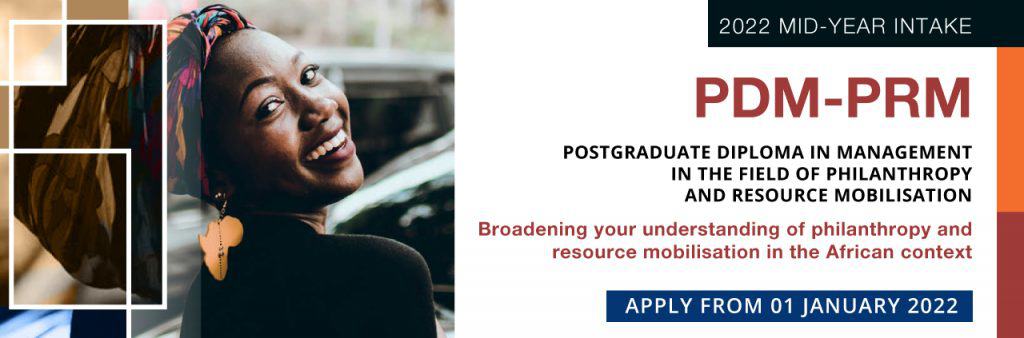
With seven masterclasses, three certificate programmes, a postgraduate diploma already underway and a Masters in Management programme on the horizon, African philanthropy has taken the centre stage as a fully-fledged academic offering at Wits Business School, targeting philanthropy practitioners and interested parties far and wide. The postgraduate diploma in management, specializing in the field of philanthropy and resource mobilization, was our new offering in 2021, in partnership with Inyathelo. The Postgraduate Diploma in Management is designed for students who are seeking specialization in fundraising, advancement and partnership building. This qualification aims at improving the skills of professionals and also sharpening the analytical and critical thinking skills of those whose career trajectory is towards academia and research.
We have also offered custom programmes tailor-made to suit our clients’ needs, such as civil society organisations in Southern Africa through the Southern Africa Trust and female artists in Southern Africa through the Women in Music Business (WOMB). We continue to enter into such bespoke programmes to ensure our clients address specific internal needs in the field of philanthropy and social investment.
To support the academic learning objective, we hosted information sessions that provided prospective students with the information they needed in order to select their programme of choice and successfully register for these. The following are links to the full information:
Look out for the new short courses, the Postgraduate Diploma and the Masters programme, all happening in 2022.
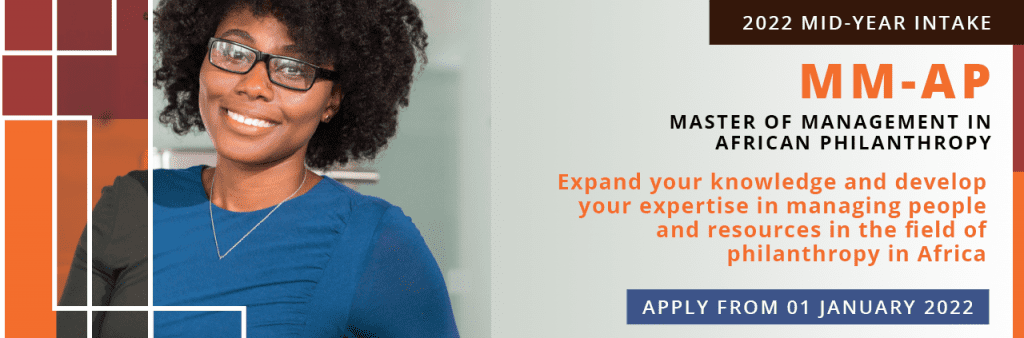
Applications for the Master of Management in African Philanthropy open on 1 January 2022.Applications for the Postgraduate Diploma in the field of Philanthropy and Resour Mobilisation open on 1 January 2022.
The year 2021, like the previous one, was challenging for everyone. CAPSI was not spared but we continued to carry out activities as they were outlined in the Centre’s Business Plan and Operations Plan. As with most donor-funded entities, both the business plan and operations plan are broken down into various donor proposals, research projects and academic programmes, among others. Most of these were executed successfully this year. However, navigating a pandemic over the last two years has not been easy.
For the first time, the Centre developed a three-year strategy that will guide everyone involved efficiently and in an effective manner, with a better understanding of where the Centre is headed in the coming years. The strategy’s strength is that it was developed by CAPSI team members and partners. This has been translated into an operations plan.
The operations pillar of the strategy is also based on the Centre’s desire to expand. We are increasing resources, upskilling, and consistently aligning staff competencies with the needs of the Centre and global trends.
For the next three years, CAPSI will focus on the following two strategy pillars:
The first is the operations pillar, which is essential for running the Centre more efficiently, effectively, and creatively. The operations pillar makes use of a variety of technological tools, that include a knowledge hub and a smartboard. Both platforms are critical for the Centre’s tracking of execution of its activities and data storage.
The second pillar is programmes. This pillar focuses on a variety of areas such as academic courses, research, training, outreach and publications. CAPSI is approaching its fifth year in operation – we have thus collaborated with CLEAR to assess our impact so far and put in place a monitoring and measurement tool to assist us in remaining relevant, credible, and up to date.
Events hosted in 2021
As the world changes, so have people’s habits. Planning and executing events in the ‘new normal’ world order has proven to be extremely difficult, putting our patience and resilience to the test with each event. Nonetheless, CAPSI was able to host a number of successful in-person, virtual, and hybrid events in 2021.